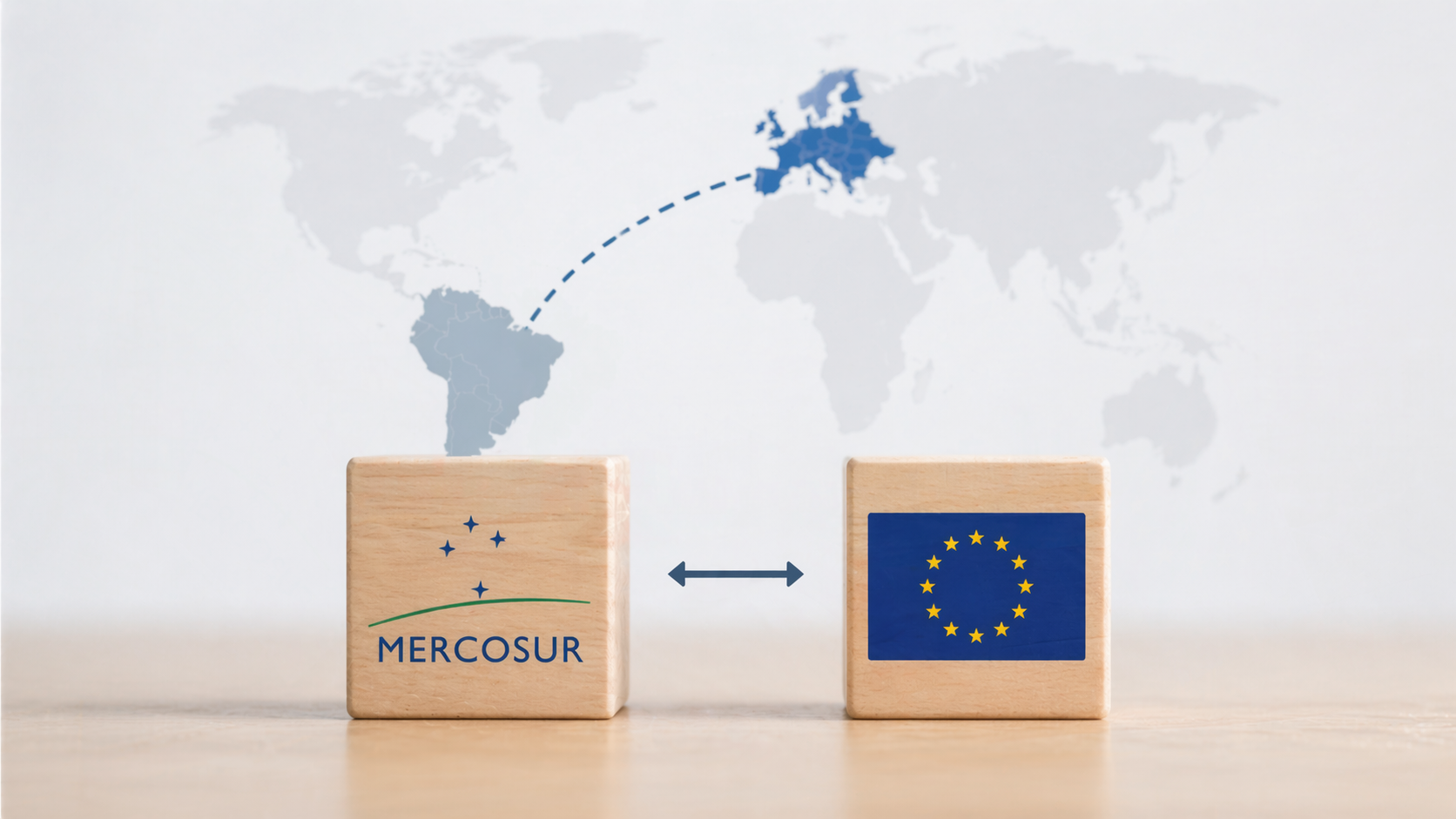
The strengthening of trade relations between Mercosur and the European Union (EU) marks a turning point in the internationalization of South American companies. The association agreement between the two blocs not only opens the Latin American market to Europe but also creates a privileged framework for Mercosur companies to access one of the most sophisticated, regulated, and high–purchasing-power markets in the world.
With more than 450 million consumers and a high per capita income level, the EU represents a strategic opportunity for Mercosur companies to diversify exports, scale their operations, and position themselves globally. This article analyzes the main opportunities, sectors with the greatest potential, and the challenges that companies in the South American bloc must consider.
1. Access to one of the largest and most stable markets in the world
One of the EU’s main attractions is its consumption capacity and its demand for differentiated high-quality products. Unlike other markets, Europe places particular value on such aspects as traceability, sustainability, innovation, and product origin.
The agreement provides for a gradual reduction of tariffs on a wide range of Mercosur products, significantly improving their competitiveness in the European market. It is especially relevant for exporters that have traditionally faced high tariffs and regulatory barriers.
In addition, the EU’s institutional stability and legal certainty provide a predictable environment for developing long-term trade relationships. Beyond exports, the European Union also represents a strategic destination for Mercosur companies seeking to establish a direct presence in the market. Establishing operations within European territory facilitates access to the single market, allowing companies to operate more efficiently across multiple countries from a single base.
2. Sectors with the greatest potential
2.1 Agribusiness and food
The agribusiness sector is undoubtedly one of the main beneficiaries. Mercosur companies have a strong comparative advantage in products such as beef, soy, sugar, coffee, fruit, and derived products. The agreement expands export quotas and reduces tariffs, facilitating access to European consumers who are increasingly interested in sustainable, organic, and certified-origin products. There is also growing interest in foods with regional identity and added value, and opening opportunities for brands that focus on differentiation.
2.2 Energy and strategic raw materials
Europe is undergoing a full energy transition, increasing demand for strategic resources. Argentine lithium, copper, and other critical minerals are essential to produce batteries and clean technologies. Likewise, Mercosur companies can position themselves as key suppliers in renewable energy-related value chains.
2.3 Industry and manufacturing
Although Europe has a highly developed industrial sector, there are opportunities for Mercosur companies in specific niches, particularly in manufacturing with competitive costs or in complementary industries. Trade integration allows Latin American companies to participate in European value chains, either as suppliers or through strategic partnerships with local firms.
2.4 Services and the digital economy
The growth of the technology and services sector opens new doors for Mercosur companies specializing in software, digital services, outsourcing, design, or technological solutions. The region’s highly qualified and cost-competitive talent represents a clear advantage in collaboration with European companies seeking to optimize processes or innovate in their business models.
3. Investment attraction and strategic partnerships
The agreement not only boosts trade but also investment between the two regions. Europe positions itself as a key source of financing, technology, and know-how for Mercosur companies.
The creation of joint ventures, strategic alliances, or subsidiaries in Europe enables faster internationalization and improved market access.
In this context, companies can benefit from:
• Partnerships with European firms
• Access to financing and cooperation programs
• Technology and knowledge transfer
Likewise, the opening of public procurement in the EU, although demanding, offers opportunities in sectors such as services, innovation, and infrastructure.
4. Opportunities for Mercosur SMEs
As in the European case, small and medium-sized enterprises (SMEs) in Mercosur can benefit significantly from the agreement.
Simplified procedures, greater regulatory transparency, and access to commercial information reduce entry barriers. This enables innovative SMEs to access highly specialized market niches.
Sectors such as gourmet foods, sustainable fashion, artisanal products, and digital services are particularly attractive for these types of companies.
5. Strategic dimension and global positioning
Accessing the European market not only brings direct economic benefits but also has a strong reputational impact.
Europe acts as a “seal of quality” in many sectors. Mercosur companies that manage to establish themselves in the EU improve their global positioning, facilitating entry into other international markets.
Moreover, in the context of global trade reconfiguration, strengthening ties with Europe allows for risk diversification and reduces dependence on traditional markets.
6. Key challenges and considerations
Despite the opportunities, accessing the European market entails significant demands:
• High regulatory standards: Strict rules on quality, food safety, environmental protection, and consumer protection.
• Sustainability requirements: Increasing pressure around ESG (environmental, social, and governance) criteria.
• Intense competition: A highly competitive market with well-established local players.
• Entry costs: Regulatory adaptation, certifications, and logistics may require significant investment.
The ability to adapt will be key to success in this environment. In many cases, overcoming these challenges requires specialized local support.
Conclusion
The agreement between Mercosur and the European Union opens a historic opportunity for South American companies. Access to a sophisticated market, improved trade conditions, and the possibility of integrating into global value chains create a highly attractive scenario.
However, success will depend on strategic preparation, the ability to meet demanding standards, and the development of strong partnerships in Europe.
In this context, having a specialized partner can be decisive. Biznelp positions itself as a key ally for Mercosur companies seeking to expand into Europe, facilitating market entry, reducing risks, and maximizing opportunities in one of the world’s most demanding markets.
If you want to take the next step, contact us.