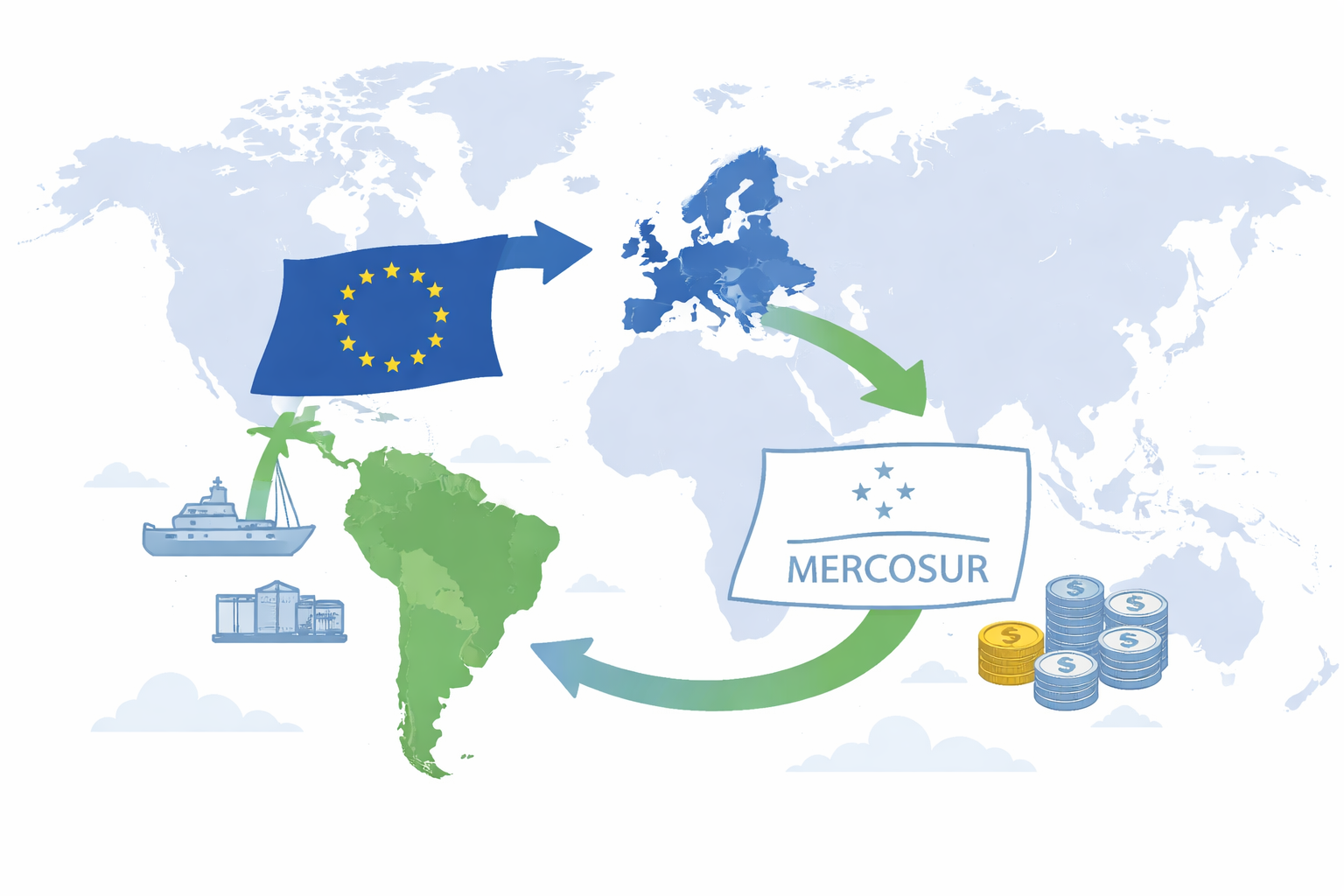
International trade is going through a period of profound change, shaped by the reorganisation of supply chains and the growing need to reduce risk. In this context, offering low costs or geographic proximity alone is no longer enough, as major economic powers seek to leverage their strategic position to strengthen their global influence. As a result, the most significant advances are now taking place through smaller, more flexible agreements, driven by the challenges and tensions of today’s environment. In this scenario, friendshoring is gaining particular relevance, with Europe and Latin America emerging as the regions offering the greatest opportunities.
The recent signing of the trade agreement between the European Union (EU) and Mercosur reshapes the opportunity landscape for companies operating on both sides of the Atlantic. This treaty, which establishes one of the world’s largest free trade areas, opens up new possibilities for preferential market access, economic cooperation and productive integration. However, it is not an isolated case. In recent years, other highly significant agreements have been concluded, including the United Kingdom’s accession to the Comprehensive and Progressive Agreement for Trans-Pacific Partnership (CPTPP), the modernisation of the EU’s trade agreements with Chile and Mexico, the formalisation of Mercosur’s agreements with Singapore and the United Arab Emirates, and progress on bilateral treaties between the EU and strategic Asian countries. The major agreements reached throughout 2024 and 2025 reflect a structural shift in international trade and point to the new direction of the global economy. In this context, having a local presence in one of these regions, or ideally in both, becomes a decisive competitive advantage.
Standing Out in the New International Trade Landscape
The EU-Mercosur agreement represents a structural shift in trade relations between the two regions, integrating a market of over 700 million consumers under a shared regulatory framework. This framework covers key areas such as trade in goods and services, investment, intellectual property, and labour and environmental standards, reducing regulatory fragmentation and increasing predictability for businesses.
Its impact will be particularly significant in terms of costs, lead times and market access. The gradual elimination of tariffs will substantially reduce entry costs in industrial, agri-food and manufacturing sectors, while the simplification of customs procedures will shorten logistics timelines and improve operational efficiency.
The agreement also strengthens investment protection and expands access to public procurement, creating concrete opportunities in sectors such as infrastructure, energy, transport, agribusiness and professional services. This will facilitate the expansion of European companies into South America while also easing the entry of Mercosur firms into the European market.
In this environment, having production, commercial or logistics operations in either the EU or Mercosur becomes a key strategic factor for capturing these advantages quickly, optimising supply chains and strengthening competitive positioning compared to companies without a local footprint.
Advantages of a Local Presence in the European Union
1. Preferential access to a large, high-value market
A local presence in the EU allows companies to fully benefit from the EU–Mercosur agreement and access a vast market characterised by strong purchasing power and high added value. Having subsidiaries, logistics centres or production facilities within European territory facilitates distribution, shortens time to market and enhances proximity to the end customer.
At the same time, the European market is governed by strict regulations and complex operating rules, where competition is built on quality, innovation, value proposition and regulatory compliance. Local presence is essential to operate effectively within these regulatory and administrative environments.
2. Reduced barriers and operational optimisation
Although the agreement provides for the gradual elimination of tariffs, complex technical, sanitary and regulatory requirements remain in place. Local establishment makes it easier to manage these obligations, reduce certification and compliance costs, and integrate more efficiently into European supply chains, improving logistics and lowering the risks associated with intercontinental routes.
3. Strategic and reputational positioning
Being present in the EU strengthens corporate image by associating brands with high standards of quality, sustainability and innovation. This enhances the global positioning of Mercosur companies and supports their expansion into other international markets.
Advantages of a Local Presence in Mercosur
1. A production platform to supply the EU
From a European perspective, Mercosur represents a highly competitive platform for industrial and agri-industrial production. Establishing operations in countries such as Paraguay allows companies to operate at very low costs, while Brazil and Argentina offer strong technological and industrial capabilities, and Uruguay and São Paulo stand out as major financial services hubs.
In addition, the region provides privileged access to strategic energy and mineral resources that are scarce or unavailable in Europe. This availability is crucial both for the energy transition and for securing critical raw materials needed for advanced manufacturing and European security and defence industries.
2. Access to a dynamic and growing market
A presence in Mercosur enables companies to benefit from rising domestic consumption, the expansion of the middle class and the development of infrastructure- and technology-intensive sectors. The agreement with the EU further reinforces this trend by facilitating investment, technology transfer and productive modernisation.
3. Regional integration and economies of scale
Operating within Mercosur provides access to an expanded market with lower tariff barriers and increasing regulatory harmonisation. This supports economies of scale, streamlines production processes and consolidates efficient export platforms to Europe and other global markets.
Conclusion
The new international trade environment, shaped by geopolitical fragmentation, supply chain reconfiguration and the search for greater resilience, is driving a more flexible, selective and strategic integration model. Within this context, the EU-Mercosur agreement stands out as a key instrument for strengthening economic cooperation between two complementary regions, creating a stable, predictable and highly attractive framework for investment and business development.
Local presence, both in the European Union and in Mercosur, is emerging as a decisive factor in fully capturing the opportunities offered by this new environment. Establishing operations in the EU provides access to a high-value market, optimises operations and strengthens reputational positioning, while setting up in Mercosur enables cost reduction, access to strategic resources, competitive production and expansion into fast-growing markets.
Ultimately, companies that adopt a dual-location strategy and leverage the advantages of both regions will be better equipped to compete in an increasingly demanding, volatile and competitive global landscape. The combination of preferential market access, operational efficiency, productive integration and strategic positioning will become a decisive advantage in leading the next phase of international trade.
If you would like to learn more about the EU-Mercosur agreement, assess its impact on your industry or explore how your company can establish an effective presence in both regions, don’t hesitate to get in touch with us.